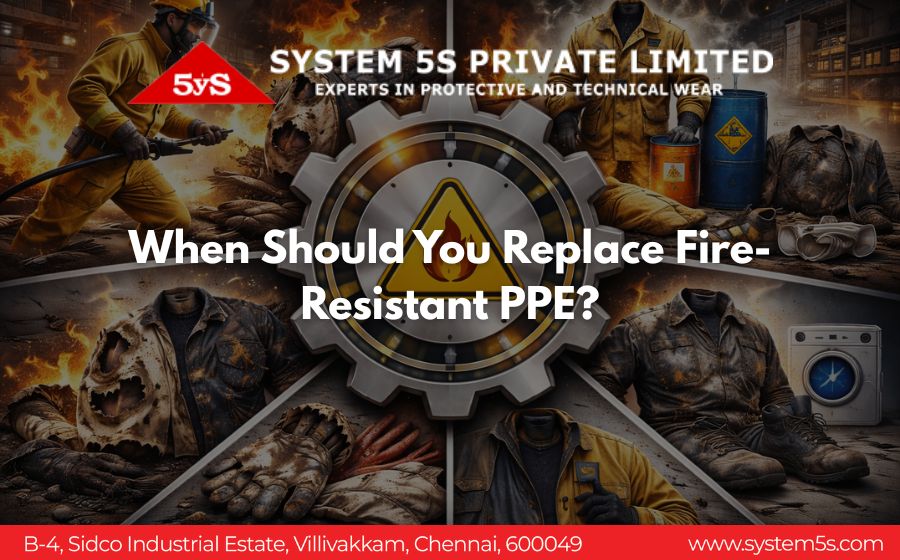
Fire-resistant PPE should be replaced when damage, contamination, poor fit, or age make protection unreliable. Use standards-based inspection and recordkeeping so Safety Gear PPE and Protective Clothing and Equipment decisions remain consistent.
Occupational Safety and Health Administration requires that defective or damaged PPE not be used. For firefighting PPE, ISO 23616 ( from the International Standards Organisation) or NFPA 1851 (from the National Fire Protection Association) flags soiling/contamination and physical or thermal damage (rips/tears/cuts; burn holes/charring/melting/discolouration; missing closures) during routine inspections.
| Signs to Replace | Typical Cause | Recommended Action |
|---|---|---|
| Burn holes, charring, and melting | Flame/heat exposure | Remove from service; evaluate; retire if not repairable |
| Tears, failed seams, broken closures | Abrasion/snagging/wear | Tag out; repair only via approved provider |
| Unknown residue or strong chemical/oil staining | Chemical/hydrocarbon exposure | Quarantine; consult manufacturer/verified cleaner; retire if not restorable |
| Delamination or reflective loss | Heat, UV, age, and laundering | Advanced inspection; replace component or retire |
| Confirmed CBRN contamination | High-hazard exposure | Immediate retirement + controlled disposal |
ISO 23616 or NFPA 1851 supports this “stop-work” approach by requiring elements needing repair to be removed from service and tagged, directing consultation for contaminant-specific processing, and requiring immediate retirement for certain high-risk contamination.
ISO 23616 or NFPA 1851 sets a practical cadence: routine inspection upon issue, at the beginning of each duty period, and after each use; plus an annual advanced inspection (and when routine inspection suggests damage), with documented findings.
It also expects element-level records, issued-to, month/year of manufacture, inspection and advanced cleaning/decontamination history, repairs, retirement date, and disposal method to justify replacements.
Treat “5 years” as a hard stop, not a target. ISO 23616 or NFPA 1851 mandates retirement of structural and proximity ensembles/elements no more than 5 years from manufacture (and sets a shorter limit for proximity reflective outer shells).
Service life can be shorter: the standard notes that PPE may need to be retired sooner and directs retirement when gear is worn/damaged or contaminated, so cleaning/repair is not possible or not cost-effective.
Cleaning is part of the replacement decision. ISO 23616 or NFPA 1851 requires cleaning capability, prohibits home/public laundering of soiled or contaminated elements, and calls for advanced cleaning at least every six months for issued/used ensembles (with one aligned to the annual advanced inspection).
It also requires providing users with the manufacturer’s care/use/maintenance instructions and warnings, which are critical because incorrect processes can degrade performance and fit (work & wear).
Manufacturer manuals add detail; MSA guidance for Cairns fire helmets, for example, calls for inspection after each use/cleaning and warns that damaged helmets must never be used.
Where hazardous substances are involved, OSHA requires protective clothing and equipment to be decontaminated, maintained, or replaced as needed to stay effective.
A simple disposal and replacement workflow for safety equipment supplies:
tag-out → quarantine → assess/clean/repair (approved only) → retire if needed → dispose so it cannot be reused → replenish spares and update records
Replacing firefighting PPE is not just about compliance; it’s about protecting lives. If your protective clothing and equipment show signs of damage, contamination, poor fit, or have reached the end of their service life, they must be removed from use immediately. A proactive replacement strategy ensures your Safety Gear PPE remains reliable in critical moments.
At System 5S, we understand the importance of durable, certified protective clothing, firefighting PPE, and comprehensive safety equipment for demanding environments. As a trusted manufacturer and provider of high-performance work & wear solutions, System 5S helps organisations maintain the highest safety standards with quality-tested gear designed for real-world hazards.
When it’s time to inspect, replace, or upgrade your Safety Gear PPE, choose System 5S, because safety should never be left to chance.
Fire-resistant PPE should be replaced immediately if it shows burn holes, charring, melting, torn seams, contamination, or poor fit. It must also be retired after 5 years from the date of manufacture under ISO 23616 or NFPA 1851. System 5S recommends routine inspections to ensure firefighting PPE remains compliant and fully protective.
Structural firefighting PPE has a maximum shelf life of 5 years from the manufacture date as per NFPA 1851 or ISO 23616 . However, System 5S advises replacing protective clothing and equipment earlier if damage, contamination, or performance degradation is detected during inspections.
Protective clothing and equipment supplied by System 5S should be retired if you notice:
If these conditions cannot be restored through certified processes, replacement is required.
Yes, but only by approved and qualified repair providers. If damage affects thermal layers, moisture barriers, or structural integrity, the PPE must be retired. System 5S supports certified repair and replacement workflows to maintain compliance and firefighter safety.
Yes. If contamination cannot be fully removed through advanced cleaning procedures, retirement is mandatory. In cases of confirmed CBRN exposure, immediate disposal is required. System 5S provides compliant safety equipment supplies designed for high-risk operational environments.
No. NFPA 1851 prohibits home or public laundering. Improper washing can degrade flame resistance and moisture barriers. System 5S provides manufacturer-approved cleaning guidance to ensure protective clothing and equipment maintain certified performance.
Timely replacement ensures maximum thermal and mechanical protection in real-world emergencies. System 5S designs and supplies certified fire fighting PPE and protective clothing and equipment built for durability, but no gear should remain in service beyond safe operational limits.
If you want, I can next remove the PDF metadata lines too and give you only the clean article body for copy-paste into the blog CMS.

