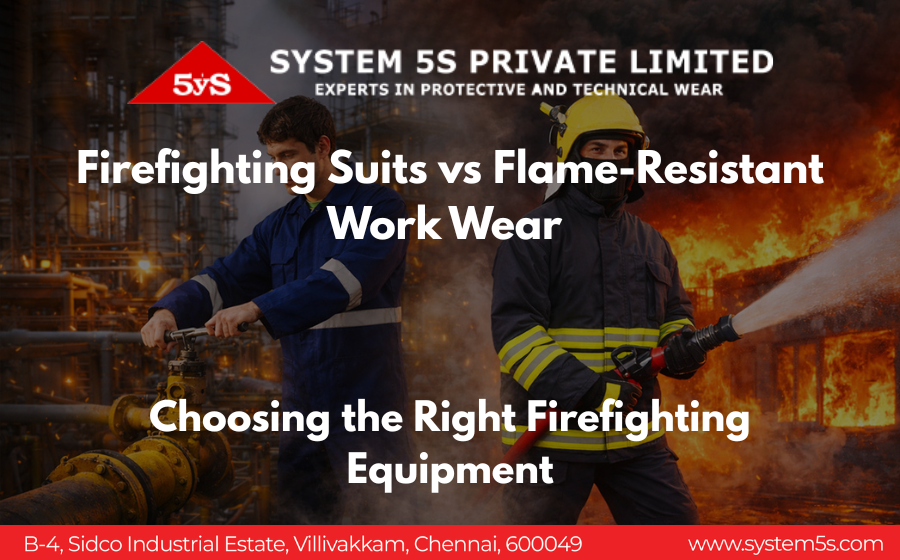
When it comes to firefighting equipment, not all protective gear is created equal. Procurement managers often encounter two categories of flame-protective gear: heavy-duty firefighting suits used by firefighters and flame-resistant work clothing commonly used in industrial settings. At a glance, they might seem similar: both offer fire protection, but their purposes, materials, performance, and compliance standards differ significantly. Understanding these differences is key to making informed, cost-effective purchasing decisions while remaining safety-conscious.
Procurement managers need a clear comparison of these two types of protective clothing to ensure they buy the right gear for the right job. Below, we break down the distinctions between firefighter suits and flame-resistant clothing in terms of intended use, construction, protective performance, and safety compliance. We’ll also highlight how System 5S addresses both needs through its product offerings, and conclude with tips to guide your procurement decisions.
FR workwear is usually made from single or dual-layer speciality fabrics that resist ignition.
Firefighting suits, on the other hand, are much more complex. They are multi-layered ensembles built to insulate and protect the wearer from extreme heat. A typical structural firefighter suit has three key layers:
Firefighter suits are built with multiple protective layers, including Nomex® and Kevlar® blends that resist ignition and withstand extreme heat. A thermal liner reduces heat transfer, while a moisture barrier blocks scalding steam and hot water from reaching the skin.
Because of this advanced construction, firefighter suits are heavier and bulkier than standard flame-resistant (FR) workwear. They also feature added reinforcements, rescue-harness options, and high-visibility reflective trim, essential elements designed for protection in burning environments.
In summary, FR clothing is designed like regular clothing but made from flame-resistant fabric, whereas a firefighter suit is engineered as high-tech armour against fire. The former optimizes a balance between protection and comfort for daily wear, while the latter sacrifices lightness and breathability in favor of maximum protection.
Flame-resistant (FR) clothing is designed for short-term exposure to heat or flames. In incidents like flash fires or arc flashes, FR garments self-extinguish, helping reduce burn severity and giving workers crucial seconds to escape.
However, FR clothing is not meant for prolonged fire exposure. Its protection typically lasts only seconds, just enough to evacuate safely. After significant exposure, the garment may be damaged or charred and should be replaced.
Firefighting suits are designed for extended exposure to extreme heat. With multi-layer construction, they allow firefighters to operate inside burning structures for significantly longer periods, often up to 30 minutes depending on fire intensity. The layers insulate against direct flames and high radiant heat, helping slow heat transfer to the body.
While even turnout gear has safety limits, it provides far greater protection than standard FR clothing. An FR jacket may protect for only a few seconds in a flash fire, whereas a firefighting suit supports sustained operations in hazardous fire environments.
Mobility and comfort also differ significantly between the two. Flame-resistant (FR) industrial clothing is lighter, breathable, and designed for all-day wear, allowing workers to move freely while performing routine tasks.
Firefighting suits, however, are heavier and bulkier, which can limit agility and increase heat stress if worn for long periods. They are intended for emergency use, not continuous wear. Each type of gear is built for specific scenarios, FR clothing for brief, accidental exposure in controlled settings, and firefighter suits for sustained operations in extreme fire conditions.
Safety standards and regulatory compliance provide another crucial point of distinction. Because these two categories of gear serve different purposes, they are governed by different standards to ensure performance.
For flame-resistant (FR) workwear, IS 15748 I India Standard ) / EN ISO 11612 (
European and ISO standard ) / NFPA 2112 ( American Standard) are some of the key standards that sets requirements for garments protecting against flash fire. Certified FR clothing must pass tests for flame resistance, heat transfer, and self-extinguishing performance.
Depending on the industry, other standards may also apply, such as ASTM F 1959 (arc flash protection) and EN ISO 11611 (welding protection ). Procurement managers should always verify certification labels and documentation to ensure the flame-retardant properties are tested, compliant, and not just marketing claims.
Firefighting suits are governed by stricter, specialized standards. In the U.S., structural firefighting gear must meet NFPA 1971, which sets requirements for flame resistance, thermal insulation (TPP ratings), moisture protection, and overall durability.
In INDIA , IS 16890 :2024 ( Category 1 & Category 2) defines similar performance benchmarks for structural firefighter clothing.
In Europe, EN 469 (Level 2) defines similar performance benchmarks for structural firefighter clothing.
Reputable fire suits clearly state compliance with these standards.
Other related standards, such as EN ISO 15384 (wildland firefighting standard in Europe ) NFPA 1977 (wildland firefighting standard in USA ) and ISO 23616 ( European and ISO , care and maintenance standard) NFPA 1851 (American , care and maintenance standard ), may also apply. For procurement teams, verifying certification is essential, not only for safety but also for regulatory compliance. Proper labeling and documentation ensure the gear has been rigorously tested and will perform reliably in life-threatening conditions.
As you evaluate options, it helps to know that some suppliers provide both categories of protective clothing, simplifying your procurement process. System 5S is an integrated provider, offering a full range of fire safety and personal protective equipment. In fact, System 5S has decades of experience (since 1990) in crafting safety equipment; its product lineup ranges from certified firefighting suits to flame-resistant workwear and even electrical
arc flash suits. This means you can source both the heavy-duty firefighter gear and the daily-use flame-resistant apparel from a single reliable manufacturer. All System 5S gear is engineered to meet relevant international standards, ensuring you aren’t compromising on compliance or quality.
Notably, System 5S has demonstrated leadership in safety compliance; it was the first company in India to obtain EN 469 certification for firefighting suits back in 2003. IIt was the first Company to obtain the IS 1689 License in 2021 . The company also maintains in-house testing facilities for both its firefighting suits and its flame-retardant workwear, so each product is rigorously tested for performance before it reaches the customer. For a procurement manager, this offers peace of mind, you’re dealing with a provider that not only sells the gear but also verifies it meets the promised protection levels. In general terms, System 5S’s offerings include advanced firefighter suits (turnout gear) built for maximum heat and flame protection, as well as a variety of flame-resistant clothing for industrial workers (such as FR jackets, coveralls, and pants for industries with fire hazards). By partnering with such a supplier, companies can equip their firefighting teams and industrial staff with the appropriate gear, confident that all items are compliant and high quality. While specific product models aren’t needed here, it’s clear that System 5S covers the spectrum
from firefighter suits to flame-resistant wear, making it easier to standardize safety equipment across different departments or hazard scenarios.
In summary, firefighting suits and flame-resistant clothing serve distinct roles, and understanding these differences will help you choose the right one for your needs. A firefighter suit is highly specialized gear for extreme fire exposure, whereas flame-resistant workwear is protective everyday clothing for jobs with fire risks. To conclude, here’s a quick recap and procurement checklist:
By keeping these points in mind, procurement managers can confidently differentiate between firefighting suits and flame-resistant wear and make informed decisions. Ultimately, the goal is to protect your workforce with gear that is fit for purpose, providing firefighters with suits that enable them to do their heroic jobs safely, and outfitting other personnel with flame-retardant clothing that keeps them safe in hazardous but more controlled environments. With the right information and equipment, you’ll ensure safety compliance and
peace of mind for everyone relying on you to protect them from the dangers of fire.
A firefighting suit is designed for direct and prolonged exposure to extreme heat and flames during rescue and fire operations. Flame-resistant (FR) clothing is meant for industrial workers who may face brief or accidental exposure to fire, sparks, or arc flashes.
No. FR clothing is not suitable for active firefighting. It protects against short-term exposure and helps workers escape safely, but it does not provide the multi-layer insulation required for structural firefighting.
Firefighting suits have multiple protective layers, including an outer shell, moisture barrier, and thermal liner. These layers protect against extreme heat and steam, making the suit heavier and bulkier than standard FR clothing.
FR clothing typically follows standards like IS 15748 or ISO 11612 or NFPA 2112 . Firefighting suits must meet stricter standards such as IS 16890 or EN 469 or NFPA 1971, which ensure protection during structural firefighting.

